Introduction
Every electronic device generates heat. In an ideal world, you could simply open a window and let the breeze carry it away. But inside a sealed server rack, a medical ventilator, or a compact 3D printer, there are no windows. That's where forced-air cooling comes in—and that's where engineers face a critical question: should you use an axial fan or a blower?
At first glance, they seem to do the same job. Both spin. Both move air. But the way they move air—and the kinds of obstacles they can push it through—are fundamentally different. Choosing the wrong one can mean the difference between a device that runs cool for years and one that overheats within months.
In this article, we'll break down how each type works, where each one excels, and how to make the right call for your specific application. If you're sourcing cooling components for an upcoming project, this comparison should help you move forward with confidence.
How an Axial Fan Works
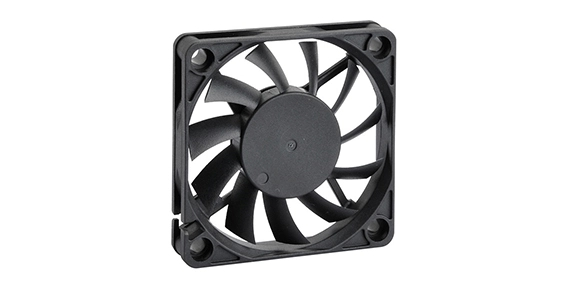
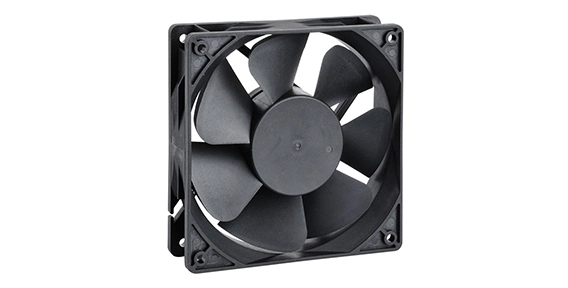
An axial fan is what most people picture when they think of a cooling fan. It has a motor, a hub, and several blades that rotate around an axis—hence the name. Air enters from behind the fan and is pushed forward in the same direction as the axis of rotation, traveling in a straight line.
The key characteristic here is high airflow with low pressure. An axial fan can move a large volume of air quickly, but it doesn't push that air with much force. Think of a desk fan: stand right in front of it and you feel a strong breeze. But put a filter or a dense heatsink in the way, and the airflow drops dramatically. That's because axial fans struggle against resistance, known in engineering terms as static pressure.
Axial fans are ideal for applications where the airflow path is relatively open: ventilating a room, cooling a PC case with unobstructed intake and exhaust, or circulating air across a broad surface.
How a Blower Works
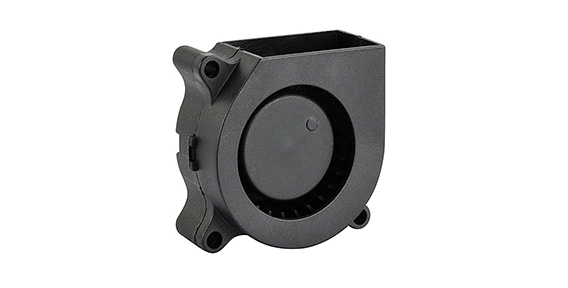
A blower (sometimes called a centrifugal fan) takes a completely different approach. Instead of pushing air straight through, it draws air into the center of a rotating impeller and then flings it outward using centrifugal force. The air exits through a dedicated outlet, typically at a 90-degree angle to the intake.
This design changes everything about performance. Blowers don't move as much total air volume as a comparably sized axial fan, but they move it with much higher pressure. That means they can force air through tight spaces, around sharp bends, and against significant resistance without losing effectiveness.
Picture a hair dryer or a leaf blower: the goal isn't just to move a lot of air, it's to move air forcefully through a confined path. In electronics cooling, blowers excel when air needs to be directed through dense fin stacks, pushed along narrow ducts, or pulled through thick filters.
Air Blower vs Axial Fan: Key Differences at a Glance
The following table summarizes the core differences between the two fan types in a format that’s easy to reference during the design phase.
This table is a helpful starting point, but let's dig deeper into where each type truly belongs.
Where Axial Fans and Blowers Are Used
Context matters. The same axial fan that works perfectly in a gaming desktop might fail entirely inside a tightly packed industrial power supply. Here's how the applications tend to break down.
Typical Axial Fan Applications
Axial fans thrive in situations where air needs to move freely across a large area. Common examples include:
Server rooms and telecom cabinets, where rows of fans circulate air through open racks. The unimpeded airflow path suits the axial design perfectly.
HVAC and ventilation systems, where the goal is bulk air movement rather than targeted pressure.
General electronics enclosures, where internal components don't create excessive airflow resistance and a steady stream of fresh air is enough to manage temperatures. In many of these systems, a DC axial fan is preferred because it delivers efficient airflow while keeping power consumption relatively low.
In all these cases, the priority is volume, not force.
Typical Blower Applications
Blowers become necessary when airflow encounters resistance. Some common scenarios:
Medical devices like CPAP machines and ventilators, where air must be pushed through filters, tubing, and valves under controlled pressure. Research from the National Center for Biotechnology Information notes that blowers used in medical ventilation systems must maintain stable flow against varying resistance—exactly the strength of a centrifugal design.
Dense heatsinks in servers or GPUs, where the tight fin spacing creates significant backpressure that an axial fan cannot overcome efficiently.
Automotive electronics, including seat ventilation and dashboard cooling, where space is tight and air must be routed through narrow ducting. In these compact systems, a DC blower fan is often used to maintain stable airflow while fitting within limited installation space.
3D printers, where a blower directs a focused stream of cooling air onto freshly extruded filament—a task that requires both precision and pressure.
The pattern is consistent: when the airflow path includes bends, filters, or narrow channels, a blower is almost always the better choice.
How to Choose Between an Air Blower and an Axial Fan
So you're designing a cooling system and need to decide. Here's a practical decision-making framework.
Start by understanding your airflow path. Is it mostly open, with a straight shot from intake to exhaust? An axial fan will probably serve you well. Is the air forced to make sharp turns, or does it need to squeeze through tightly spaced fins? Lean toward a blower.
Next, consider your space constraints. Axial fans have a slim profile, which makes them easy to integrate into flat panels and enclosure walls. Blowers, on the other hand, have a deeper housing and require clearance for their side-exhaust outlet. If your design can accommodate that footprint, the performance gains in high-resistance environments are worth it.
Think about noise as a secondary factor. Axial fans generally produce a smoother, lower-pitched sound. Blowers, because of their higher operating speeds and the nature of centrifugal airflow, tend to be louder and more directional. In noise-sensitive applications like medical devices or office equipment, this may influence your choice—though proper mounting and speed control can mitigate the difference.
Finally, match the fan to the resistance curve of your system. Every airflow path has a characteristic impedance. If your system's impedance is high, an axial fan will operate far from its peak efficiency point, while a blower will handle it comfortably. This is a concept manufacturers can help you evaluate using fan curve data.
Conclusion
The difference between an axial fan and a blower isn't about one being universally better—it's about matching the tool to the job. Axial fans give you volume. Blowers give you pressure. Understanding the airflow resistance in your system will point you toward the right choice every time.
If you're ready to explore specific models or need help narrowing down the options, take a look at our full product range or reach out to us directly. We've been helping customers solve thermal challenges for years, and we're always glad to share what we've learned.
Frequently Asked Questions
1. Can a blower replace an axial fan in a PC case?
Not directly. PC cases are designed for the high-volume, low-pressure airflow that axial fans provide. A blower would force air through a narrower path with higher pressure, which could disrupt the intended airflow pattern and may increase noise without improving cooling.
2. Why are blowers louder than axial fans?
Blowers operate at higher RPMs and generate airflow through centrifugal force, which naturally produces more turbulence and higher-frequency noise. The focused exhaust outlet also makes the sound more directional.
3. Which lasts longer, an axial fan or a blower?
Neither has an inherent advantage in lifespan. Longevity depends on bearing type (ball bearings generally outlast sleeve bearings), operating temperature, and environmental factors like dust and humidity.
4. Can I use an axial fan with a filter?
You can, but with limitations. A filter adds resistance to the airflow path. If the filter is thin and has a low pressure drop, an axial fan may manage fine. For dense filters or HEPA-grade filtration, a blower is far more effective.
5. How do I know which airflow direction I need?
For axial fans, airflow is straight through, front to back. For blowers, air enters through the center of the impeller and exits through a side port. Check the manufacturer's datasheet for airflow direction markings, and make sure your mounting orientation aligns with the intended path.
 EN
EN 
 +
+
 +
+
 +
+